By CIVICUS
Aug 10 2026 –
CIVICUS discusses India’s Cockroach Janta Party movement with Harshit Singh, a young activist, poet and storyteller who took part in protests in Delhi.
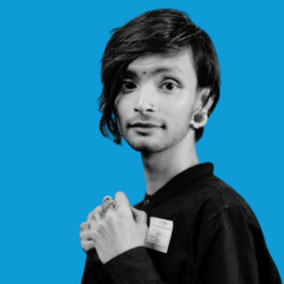
Harshit Singh
In May, India’s Chief Justice, Surya Kant, compared unemployed young people to cockroaches. The Cockroach Janta Party was born when a Gen Z movement took the insult as its name. It rapidly gained millions of followers online and mobilised street protests to demand accountability for exam leaks that forced over two million students to resit their tests, calling for the education minister’s resignation. On 20 July, police met a protest in New Delhi with pellet guns, teargas, batons and arrests. Education minister Dharmendra Pradhan resigned on 25 July.
What’s the Cockroach Janta Party, and how did it start?
On 15 May, the Chief Justice of India said that young people who couldn’t find a job and turned to media, social media and activism to attack the system were like cockroaches. He corrected himself the following day, saying he had meant only those entering the legal profession with fake degrees, but it was too late. Everybody felt hurt and frustrated.
Abhijeet Dipke, a young Indian, posted a tweet asking what would happen if all the cockroaches came together. Within 24 hours he had set up an Instagram page, a website and a manifesto that said that if you were lazy, unemployed and had time on your hands, you qualified as a cockroach. The name, Cockroach Janta Party, was a parody of the ruling party. The response was enormous. Artists and creators began promoting the platform, and within weeks over 20 million people were following it.
It grew that fast because the frustration was already there. Two weeks before Surya Kant spoke, the question paper for the national medical entrance exam leaked in advance, and the exam was cancelled for over two million students who had spent years preparing. At least 21 students died by suicide; every morning we woke up to news of another death. And this was not an isolated case. Every other day we hear about another exam paper leaking somewhere.
The Cockroach Janta Party gave young people somewhere to channel their frustration with the education system and unemployment. It gave us hope and a chance to demand a better education system, one that isn’t privatised and doesn’t cost so much that only privileged people get a good education.
But education is just the baseline. Beyond it, this is a movement that brings together everyone who has been neglected and not listened to for years, so they can express their frustration and ask for change. What started as satire became a national movement that nobody, not even the person who started it, expected.
Would you call this a Gen Z movement?
It was organised by Gen Z, and most of us in it are, but it’s not only that. I have seen every generation at the protest. People of different castes, gender identities and religions have come together under one umbrella to ask for their rights. At the end of the day, we are all Indians, and every issue this country is going through is our issue.
There is no criterion for joining and no enrolment process. If you think something is wrong, or that your basic rights are not being respected, that is the moment you support the movement, however you can. Come to the protest, talk about it online or in print, and be a voice where you are.
What struck me most is how many people came who didn’t support Abhijeet or disagreed with something a spokesperson had said. Some didn’t even like that we call ourselves cockroaches. They came anyway, because the movement is bigger than any person in it and because after a long time we have a platform where we can speak out loud, with other people standing next to us. That’s why it grew so fast.
What role has social media played?
Social media has played a central role. The movement started online and the vast majority of what it has achieved rests on that. Nobody expected it to come onto the ground and organise protests at this scale.
The reason it mattered this much is that the media here is compromised. If you say anything against the government, mainstream television and print media will not carry it. There was a protest in the heart of the capital for weeks and you wouldn’t find a single headline about it in the newspapers or magazines.
But when you are on the ground with your phone, taking photos and videos, you become your own media. And everyone was using their platforms. It didn’t matter whether someone had 10 followers or 5,000, each person was reaching the audience they had. In the end, mainstream media just reaches a limited number of people, but social media reaches everyone.
The turning point was when artists and creators started speaking. I hesitated at first. My livelihood is social media and ticket revenue, so I doubted what would happen to my future if I spoke against the government. I feared my accounts would be taken down. But I couldn’t deny what was happening, so I spoke out, and many other artists did too.
How has the government responded?
The government has responded very negatively. People who question the government, protest against it or ask for their rights get labelled as anti-national or terrorists. There’s no second thought about it. When I was a child, those were heavy words. Watching this government make them ordinary and using them against us was frightening.
For seven weeks we were at Jantar Mantar, the designated protest site in central Delhi. The Prime Minister’s Office, the President’s house and every ministry are within a five-kilometre radius. Still, not official came to meet us. What they did instead was try to dilute the protest by dividing us with anything they could find. They mocked queer people and spread hatred between Hindus and Muslims, but the unity held and we stood together.
On 20 July, we marched from Jantar Mantar to parliament. Delhi hadn’t seen a peaceful protest this massive in about 15 years. Thousands of people, including children, teenagers and grandparents, were on the streets asking for their basic rights. We were carrying flowers, banners and posters, and chanting slogans.
But the security forces met us with repression and violence. They used pellet guns, teargas and batons against anyone, even if they were just standing nearby. There’s a girl who’s still in intensive care on a ventilator.
The way the police handled the protests was illegal and unconstitutional. At that moment a lot of people in India realised something was badly wrong, and support for our movement grew massively across the country. Cities, districts and small towns started protests in solidarity. That is when the government understood it had to listen.
What has the movement achieved?
Our non-negotiable demand was the resignation of Dharmendra Pradhan and action against everyone involved in the scam. Pradhan stepped down, and we are glad he did, but it shouldn’t have taken this long or this much violence. He even framed it as a way to stop the protests and prevent terrorist activity, not as an admission that anything had gone wrong. Accountability is still missing.
Our other two demands are still unmet. We asked for compensation of 10 million rupees (approx. US$115,000) for every family that lost a child to suicide. Those families haven’t received anything, not even an apology.
We also asked that nobody who took part in the protests face legal action. Instead, the police have spent the past days tracing protesters and opening cases against them. There’s a lot of rage about it, and Abhijeet and others have said we may have to protest again.
What support does the movement need now?
What we most need is for people to stop being afraid. Protesting here is almost a taboo, because people expect repercussions and stay away, which makes organising anything at all difficult.
That fear is not irrational. This government controls the security forces, the Central Bureau of Investigation and the Enforcement Directorate, and it can do whatever it wants with them, as we saw on the streets. The courts will not stop it either, because the judiciary is compromised in the same way the media is.
But if something is wrong, it is fine to ask the government why. They are here to serve us. All we are asking for is to be able to protest peacefully in what is supposed to be the world’s largest democracy.
We need young people in this country to keep showing up and artists to stop being silent, because if the mainstream media will not speak out, art must become the mode of resistance. Support from abroad matters too. When people elsewhere talk about our movement, it creates pressure on the government. And we must hold on to what we know – our rights and our intentions – because diluting the agenda is what the government will try next.
CIVICUS interviews a wide range of civil society activists, experts and leaders to gather diverse perspectives on civil society action and current issues for publication on its CIVICUS Lens platform. The views expressed in interviews are the interviewees’ and do not necessarily reflect those of CIVICUS. Publication does not imply endorsement of interviewees or the organisations they represent.
India has recently been added to the CIVICUS Monitor Watchlist, which identifies countries where a severe deterioration in the quality of civic space is taking place.
GET IN TOUCH
Instagram
SEE ALSO
India added to human rights watchlist as repression intensifies in Modi’s third term CIVICUS Monitor 29.Jul.2026
Gen Z protests: new resistance rises CIVICUS | 2026 State of Civil Society Report
India: ‘When civil society is constrained, it cannot challenge power or amplify excluded voices’ CIVICUS Lens | Interview with Devanshi Vaid and Smarinita Shetty 11.Dec.2025
!function(d,s,id){var js,fjs=d.getElementsByTagName(s)[0],p=/^http:/.test(d.location)?’http’:’https’;if(!d.getElementById(id)){js=d.createElement(s);js.id=id;js.src=p+’://platform.twitter.com/widgets.js’;fjs.parentNode.insertBefore(js,fjs);}}(document, ‘script’, ‘twitter-wjs’);



 Saudi Riyal Exchange Rate